RECOGNITION WORKS!

We give an award to the top sales guy, to the person with 25 years of service, to the truck driver with 1 million miles without a chargeable accident. We believe in the power of recognition. The why we do it may seem obvious, but it is a lot more than that.

We use recognition to:

  • Create a culture within the company that affects every attitude.

  • Say thanks and applaud success.

  • Teach others what we as an organization want to achieve.

  • Increase retention of employees.

  • Support Mission and Values.

  • Engage employees.

  • Encourage loyalty.

  • Increase customer satisfaction.

  • In summation, we believe in using recognition everyday to improve the bottom line. If that's important to you, then we're speaking the same language. Come with us on this journey.

    Take a look at the topics we have and see if we can help you with your recognition programs.

  • Need ideas for wording on an awards? See the Thesaurus.

  • Want to implement a sales award program but need to present the concept to management? Check out Sales Awards: An Overview.

  • Want to know the inside scoop on the Lombardi Trophy or the Oscars? Take a look at our ongoing series on Famous Awards.

  • Talk to us. We are here to help you.

    Thursday, February 5, 2015

    Safety Violations at Ashley Furniture: $1.7 M in OSHA Fines

    On 2/2/2015 OSHA issued a news release regarding the company, Ashley Furniture. The report described amputations, willful and repeated violations of safety and an overall environment putting company performance ahead of plant and worker safety.  OSHA found that the company did not take steps to protect its workers.

    According to OSHA, "A willful violation is one committed with intentional, knowing or voluntary disregard for the law's requirement, or with plain indifference to employee safety and health. OSHA issues repeated violations if an employer previously was cited for the same or a similar violation of any standard, regulation, rule or order at any other facility in federal enforcement states within the last five years."

    Companies today are looking at Employee Engagement Strategies to effectively implement safety recognition. According to the SHRM Foundation, engaged employees are five times less likely to have safety incidents involving lost time.

    Further, a 2013 Gallup Study found that companies in the top quartile of employee engagement had:

    • 48% fewer safety accidents
    • 21 % higher productivity
    • 22% higher profitability
    • 41% higher quality
    • 37% reduced absenteeism
    Clearly, this suggests that good safety engagement of the workforce results in a more profitable company, certainly the overall goal of Ashley Furniture. 


    How Safety Impacts Employee Engagement

    An engaged workforce is more likely to take an active interest in the well-being of their organization. They will want to strengthen profitability and productivity because they see that their contributions are being appreciated. Employees will not only work more deliberately and efficiently, but will be proactive in preventing on-the-job accidents.

    Maintaining a Safe & Engaged Work Environment

    By engaging your employees to maintain a safe and healthy work environment through the use of recognition, your organization will have a higher likelihood of exceeding organizational goals. Your organization can create a culture of safety and recognition by recognizing employees for such proactive behavior as:
    • Participation in Safety Training and Meetings
    • Making Suggestions
    • Reporting Near-Misses
    • Mentorship Programs

    How RCB Awards Helps Employee Engagement


    RCB Awards uses the People Are™ employee engagement platform. This empowers an organization to create a culture of recognition through all aspects of the business, including safety. By incorporating the three-dimensional descriptors of recognition, formal, informal, and day-to-day, companies are able to keep business objectives top of mind, while achieving the strategic goals it has in place.

    Contact RCB for more information: 1-800-929-9110. Safety Recognition Specialist

    Posted by Curt Denevan:

    Tuesday, January 13, 2015

    7 New Rules for Developing a High Performance Team Culture

    Posted by Curt Denevan:

    The year 2015 has the potential to bring incredible opportunity to businesses across the globe. Over the past month, there have been many predictions about what the new year will hold, and one common thread is the thought that our complex world can be made simple. Many talk about technology and automation, software integrations and cloud computing, and simplifying complex processes.

    Behavior Change is the Backbone of Employee Engagement

    Simple sounds good, right? But when it comes to engaging employees, simple is not the word that may come to mind. Most of us, if asked, could come up with a list of behaviors we would like to see from our employees, and a list of behaviors we do not want to see. Engaging our teams begins with understanding that what we wish for is really just simple behavior change. After all, to us, it's not rocket science; Am I right?

    We want our employees to show up every day, be productive, be safe at work, take care of their own well-being, be mindful and present at work, and to measurably move the needle for us.

    Research tell us that in order to consistently see these types of behaviors in our workplaces, we need to have a culture of engagement. Look at what is possible when you have an engaged team:

    A 2013 Gallup study found how companies in the top quartile of employee engagement compared with those in the bottom quartile exhibited:

        21% higher productivity
        22% higher profitability
        41% higher quality
        48% fewer safety accidents
        37% reduced absenteeism

    The dramatic increase in profitability and productivity alone has the power to transform companies into high performance mode. And the KPIs measured in the Gallup study indicate that we have the potential to catalyze behavior change … and it's really not that hard.

    The 7 New Rules of Employee Engagement

    To help you understand what it takes to see these kinds of changes within your organization, the CA Short Company wrote The 7 NEW Rules of Employee Engagement. As you can see below, it all begins with creating a culture of engagement through recognition.

    1.     Culture: Create a culture of recognition that resonates through all aspects of the organization. Incorporate formal, informal, & day-to-day recognition into the strategic recognition platform.
    2.     Resources: Empower employees to develop new skills and advance their careers. Reward those employees who use those opportunities to learn and improve.
    3.     Communication: Consistently communicate and live your organization’s values & vision. Recognize those employees who impact the quality of the organization’s work, products, and services.
    4.     Appreciation: Value your employees and their ideas. Recognize employees for providing input and for taking initiative outside of their daily responsibilities.
    5.     Well-being: Promote work-life integration. Recognize employees who make positive & healthy lifestyle changes that improve the quality of life.
    6.     Enthusiasm: Inspire enthusiastic performances from your employees. Reward employees who show commitment to the future of your organization and are dedicated to making it a success.
    7.     Safety: Encourage employees to work both efficiently and safely. Recognize those employees who maintain a safe and healthy working environment for themselves and others.

    At the C.A. Short Company, the prediction for 2015 is that engaged teams will emerge and carry their companies to be among top performers. Easy? Not necessarily. Worth it? In spades. That's why they've built an innovative recognition platform that they're bringing to the market, based on the 7 New Rules of Employee Engagement. To request a private beta demo, contact curtd@rcbawards.com.

    Let us know your thoughts - we'd love to hear your ideas about additional ways to engage employees in order to create high-performance teams.

    Tuesday, June 10, 2014

    Creating a Culture of Recognition

    Posted by Curt Denevan:

    Alpha Source Corporation wanted to create a culture of recognition. In identifying what was needed, they had several key goals:
    • Company had a new management team in place and old habits needed to change
    • A growth plan had been added to the business model, and all employees needed to embrace the coming changes
    • A certain attitude of "We've always done it that way, why should I bother changing..." permeated throughout the company.
     Consultants from Recognition Pro were able to come in and offer an overview of what recognition can do for the management team. This was then taken to a training session, Recognition 101, in which all front line supervisors were taught how to use recognition effectively. A software program that tracked all recognition events and how they were implemented allowed the CEO the ability to see how recognition was impacting the company. Employees were positive about the changes, loved the way the company respected and recognized their contributions, and were excited as the program went forward.

    Co-founded by Dr. Bob Nelson, author of 1001 Ways to Recognize Employees, Recognition Pro has become the premier training tool for companies looking for positive, motivated workers.

    For more information, see Recognition Pro.

    Recognize Now


    What will a Recognition Program do for you? Let's run the numbers...

    Posted by Curt Denevan:

    According to a recent survey of 80,000 employees, recognition was a principle factor in employee satisfaction and retention. The purpose of the survey was to identify critical dimensions of quality workplaces in which four outcomes were at a high level: employee retention, customer satisfaction, productivity and profitability - are all at high levels. What does this affect?

    • Supports 50% lower turnover
    • Creates 56% higher customer loyalty
    • Causes 38% increase in productivity
    • Builds relationships
    • Encourages personal achievement
    • Reinforces company goals
    • Builds employee loyalty
    • Rewards employees for performance
    • Increase profitability by as much as 27%
    Not a lot of organizations do recognition well, in fact, only a minority do. Those that do, have a recognition strategy that is multi-tiered, multi-faceted and fully integrated. As a result, a good recognition program will:
    1. Support and value employees, to positively reinforce their initiative and creativity, and to enhance business performance.
    2. Presented at different levels depending on the accomplishment significance.
    3. Be available for a wide variety of achievements and contributions, such as:
      • Innovations and improvements
      • Performance excellence and meritorious actions
      • Length of Service
    A good recognition program doesn't have to be expensive. On the contrary, most recognition programs will create lasting value, long-term return and result in a good investment. All it takes is thought and care and a willingness to acknowledge your most important assets - the people who are your company.

    Monday, February 17, 2014

    PROVIDING A CONTEXT FOR RECOGNITION: HOW TO PRESENT AN AWARD

    by Dr. Bob Nelson
    Recognition Pro: Coaching Managers to Recognize & Reward


    Regardless of what forms of incentive, recognition or rewards you are using in your organization, you will achieve higher value if you are mindful of how such items are delivered.

    Take, for example, a five-year service award.  I contend the activity of personally recognizing that employee milestone is many times more meaningful than the specific token gift that may be received.  Instead of receiving a five-year pin, logo'd jewelry or a choice of gift delivered to your desk with a form letter several months after your anniversary, most employees would be far more touched to get a personal call or visit from their manager on the day of their anniversary.  Their manager could say something like: "I noticed it was your five-year anniversary today.  Can you believe how fast the time has gone?  I can still remember your first day of work!  I was excited about having you on the team then and I'm excited about having you with us today.  Thanks for confirming my good judgment in hiring you!"

    Of course, the manager would have to take some initiative to mark his calendar in advance and take a few minutes to connect with the employee on that day, but it's exactly those personal actions that give the interaction so much meaning for the typical employee.  The thoughtful, personal touch tells the employee that although you are busy, you are not too busy when it comes to taking time for an employee.

    In another example, I know someone who had been a part of a project team that lasted for quite some time.  The team members worked hard and they achieved significant results.  Many weeks after their last meeting, coffee mugs with an imprinted name of the project mysteriously appeared on each member's desk.  My friend's reaction was "I guess this is for all the overtime I worked on that project.  Some thanks!"

    Needless to say, the lack of context given to this recognition item undermined what otherwise might have been a very thoughtful gesture of thanks and teamwork.  Whoever went through the effort and expense to provide the coffee mugs could have pulled the group together--perhaps for a celebrations lunch--and distributed the mugs at that time as a memento of the team project with individual words of thanks for each team member.  In that instance the coffee mugs would have been more likely to serve as a symbolic reminder of that shared team effort for years to come.


    Besides making recognition more meaningful, providing a context adds a practical element to the activity as well.  It gives you a chance to:
    1. Specifically identify the desired performance thus eliminating any guessing on the part of the employee and creating a strong link Between the desired performance and the reward.
    2. Generalize the specific performance to a larger category of desired behavior such as teamwork, a company value or organizational initiative.
    3. Set a public example for other employees as to what things get noticed and rewarded in your work environment.
    Thus a manager can obtain a benefit on several levels by verbally recognizing an employee as follows:  "John, thanks for working late last night to help us wrap up that proposal.  I appreciate that you did it without being asked.  It's that type of initiative that tells me you're really committed to our group and it's exactly what we need to reach the goals we've all been aiming for this year."
    Taking the time to personalize the delivery of any achievement award adds to its values for all of us.  It creates an emotional impact that seems rarely felt today in the workplace.

    By providing a context for an award or recognition item, you have a chance to tie the item and event to a larger context for the employee, thus potentially connecting one's job responsibilities to a larger framework, a deeper sense of commitment and group purpose, and ultimately to the overall mission of the organization.


    Posted by Curt Denevan:

    Tuesday, July 23, 2013

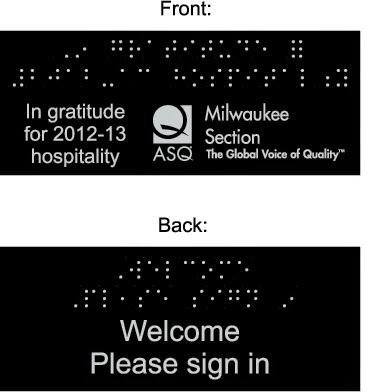
    Crystal with Braille Inscription

    RCB Awards has seen lots of unique crystal awards, but this project for ASQ (American Society for Quality), was a first for us. The customer wanted a crystal pen holder, two sided, with a greeting in braille. This was to be at the check in desk for a large meeting they were having. Since the etching process typically cuts into the crystal, this would leave recessed braille dots that would be too difficult for a finger touch to decipher.


    After much discussion over this with the customer, it was decided to break each of the designs in half, and the braille portion would be placed at the bottom and would be done as a reverse. This would etch away the background and leave the dots raised, and the text in the top portion would be done traditionally with the letters recessed.

    There is no braille translation of the ASQ logo, so that was not part of the braille portion. The actual piece turned out exactly as planned, with raised dots of braille for trained people to "read".

    Because the glass has a two sided etch, this photo does not do it justice, but you can see how the reverse portion on the bottom turned out, with the raised dots left un-etched while the background glass is removed.

    Matt Scholtes of Audio & Braille Literacy Enhancement, Inc of Milwaukee was instrumental in providing the information necessary for us to etch this project according to the braille standards.

    For more information on custom etching of crystal and unique crystal awards, contact RCB Awards.


    Posted by Curt Denevan:

    Monday, July 22, 2013

    Fantasy Football Trophies

    Fantasy Football Trophies are in demand from most league commissioners. These trophies are designed to hold a number of plates on each side of the base, allowing the winner each year to display his name.
    They can be inexpensive, as low as $85, or they can be similar to the big league trophy and cost several thousand. Typically, the commissioner unscrews a plate each year and sends it in to be engraved. To see a selection, go to Fantasy Football Trophies.

    Many of the trophies made by RCB Awards are hand made, so you may need to allow extra time to have them made for you.

    Posted by Curt Denevan:

    Monday, June 3, 2013

    Motivation or Incentive?

    Posted by Curt Denevan:

    What is the difference between incentive and motivation? An incentive is often an external influence that persuades an individual to act in a certain manner. Sell more goods, get a bonus. This works often with cash bonuses, trips and valued items like an I-Pad.

    So what is motivation? Try looking at this as a psychological feature that drives one to act toward certain desired goals. It can be viewed as an internal driver that affects behavior. This is what really pushes someone to achieve great things. Internal motivation can be the strongest factor. Call it internal drive, a burning desire, focused, or any one of those descriptors, it boils down to a driving internal force that compels someone to act in a certain way, to achieve certain accomplishments.

    So where does recognition belong in this equation? The most successful awards are a combination of both. A symbolic plaque or freestanding award embraces the external aspect of incentive. As a constant reminder on your employees walls and desks, symbolic recognition is continually enticing them to perform or act in a certain way. Yet, physical awards move a step beyond incentive. When awards are symbolic, they last years after the gift cards, cash bonuses and trips are used. When this occurs, awards become motivation. A displayed award fuels an employee's pride and self worth, speaking to internal psychological senses that drive performance toward goals. It often serves to create office peer pressure, that gives motivation to others that didn't even receive the award.

    For more information, contact RCB Awards at 800-929-9110 or visit RCB Awards.

    Tuesday, April 30, 2013

    Words for Effective Recognition

    Posted by Curt Denevan:


    Words have a powerful impact on a recognition presentation. Using the wrong words can often have devastating effects. Using the best words can have a tremendous positive influence. Practice is the best teacher, but perhaps here we can share some ideas.

    5 Most Important Words to Always Use:

    Results (result, resulting or similar) – “Your persistence in completing this project on time resulted in an immediate re-order by the customer!”  You are demonstrating the correlation between action and the impact of that action. By showing this in a social recognition, peers get boosted by this and learn that their efforts also can be appreciated.

    Thanks (thank you) – Too many times a simple recognition moment fails to say “thank you”. It’s pretty basic, but the point is to let the recipient know that you are indebted to them for what they did. “Thank you for your commitment to the new policy, it made a difference here.”

    You – Recognition experts describe this as THE most important word to use in a presentation. It makes the recognition personal and relevant, it gets people’s attention. It also forces you to be specific about what you are talking about. “You really did a fantastic job with the Johnson presentation”.

    Their Name – Scientific studies demonstrate that when you hear your name, your brain gets focused and attentive. Try to use their name at least 3 times in a recognition presentation. Even better when the name is in the middle of the sentence, as it is less likely to be glossed over.  “The entire management team noticed what you did Sherry, and we are all very appreciative”.

    Because – This is one of those words that will have an important point following it, which gives it greater credibility and makes it more powerful. “Tina, because  of the time you spent straightening out that situation, we were able to keep production going and didn’t lose any time”.

    What are some other impact words?

    Words for Effort
    Overcome, succeed, excel, achieve, grasp, generate, develop, design, productive, accomplish, volunteer, produce, discipline, create, resolve, execution, triumph, victory, complete, masterpiece, conquest, initiative, outcome

    Words for Quality
    Organize, improve, excellence, exceptional, striking, aware, brilliant, elegant, eloquent, intuitive, strong, outstanding, merit, talent, distinction

    Words for Attitude
    Thoughtful, responsible, creative, energetic, enthusiastic, resourceful, motivated, dedicated, innovative, reliable, vibrant, wise, flexible, versatile, consistent, considerate, commitment, confidence, imagination, passion, tenacity

    Words for Leadership
    Capable, oversight, vision, navigate, command, conduct, cutting-edge, star, champion, vanguard, role-model, respect, direction, insight, inspiring, admired, courageous, engaging, enterprising, invincible, masterful

    Words for Teamwork
    Help, support, benefit, advocate, save, encourage, revive, dependable, reliable, prepared, cooperation, advice, fortify, sponsor

    These were presented by Darcy Jacobson at Globoforce. For more ideas, go to the RCB Awards Recognition Thesaurus and also check out the Award Text Suggestions - Plaque Wording - Crystal inscriptions.

    Friday, April 5, 2013

    Cash for Recognition

    Posted by Curt Denevan: We've all heard the stories of a Sales Manager that doesn't believe in awards, that he just hands out cash as recognition for achievement. While there is considerable evidence to debunk this line of thinking, the below clip from Jerry Seinfeld says it better than any article out of the Harvard Business Review.

    Tuesday, January 8, 2013

    Posted by Curt Denevan:

    Interactive Donor Walls bring a whole new dimension to donor recognition.

     
    With 25 menus that we can customize, video that is embedded, donor stories, Gifts in Action, Major Donor Profiles and annual donor lists, this dynamic and easy to update system allows the college to have a strong tool in cultivating donors. An interesting attractor loop runs when not in use, and serves to draw interest. Once the interactive screen is touched, it comes alive with the main menu. Working through the information, users find how philanthropy has been an important force, what has been accomplished with these major gifts, and how the college uses the funds. There is even a fun quiz about campus life! A tab for alumni highlights the importance of giving after students leave the college and enter the working world.

    The installation is in an old display case. The front is glass, with a film on the inside that is back lit allowing the  campus scene to glow. It's pretty dramatic.

    Monday, May 7, 2012

    Posted by Curt Denevan:


    Awards Capture Attention Over “CASH” Recognition


    Companies unsatisfied with performance and that rely on cash alone to reward and incentivize their staff may be interested in a study conducted by Shaffer and Arkes (2009), that found that when people make a hypothetical choice between cash and non-cash incentives, cash is indeed preferred by many employees. However, and here’s the hook, when it’s no longer hypothetical, meaning when an award is identified, employees actually performed better in pursuit of it, even when the award was of equal value to the cash alternative.  As organizations look to do more with less, the argument can be effectively made that introducing a non-cash component to a pay-for-performance scheme may make it more effective and therefor, more efficient than one with an all cash payout.
    Today over 83% of firms have some sort of performance based pay in place. While they have bought into the concept, may are still asking if they are getting the rate of return that they anticipated. The satisfaction gap opens a window for award providers to suggest/position non-cash recognition as an alternative incentive.
    A study this year by Jeffrey & Adomdza (2011), found that non-cash awards capture employee attention. The authors concluded that employees think more frequently about these awards, even when they are in equal value to cash, and that the increased interest leads to higher performance.
    A comparative study published in The Journal of Personal Selling and Sales Management compared cash versus non-cash rewards among 45 insurance agents. The study revealed that travel and entertainment outperformed cash as incentives for agents to acquire new customers.
    The conclusion that cash is always more effective simply doesn’t hold up with study after study refuting this notion.  These recent studies show that awards, merchandise and non-cash incentives offer more influence over people and can be more powerful-and more profitable-than cash alternatives.

    For more information, contact RCB Awards at www.rcbaward.com. 

    Thursday, April 19, 2012

    Sportsmanship Awards Donated by RCB

    Posted by Curt Denevan:


    On Wednesday April 18, Curt Denevan of RCB Awards announced that the company, in conjunction with the Journal Sentinel Preps Plus, will donate a Sportsmanship Award to every local high school in southeastern Wisconsin. These awards are meant to highlight in each high school examples of great sportsmanship on the field of play. Too often class athletes are overlooked unless they are the leading scorer. This award allows the athletic director to select the student athlete that demonstrates the true spirit of sportsmanship. 

    RCB will also donate Academic Achievement Award to recognize outstanding academic honors. Each high school principal will be asked to determine their criteria for the award. The idea is that there are students who really put in extra effort and succeed. They should be recognized, not just the Valedictorian.

    An announcement was sent to each southeastern Wisconsin athletic director and principal this week explaining the program and asking them to select their award recipients.

    For additional information on awards for athletic and academic achievement, contact Curt Denevan or visit www.rcbawards.com.  RCB Awards is an award and recognition firm based in Milwaukee, Wisconsin specializing in non-profit and corporate award programs for the last 20 years.

    Wednesday, March 28, 2012

    Over Half the Workforce not Satisfied with Recognition

    Posted by Curt Denevan:

    • 39% of workers don't feel appreciated at work
    • 52% are not satisfied with the level of recognition they receive
    • 38% are actively looking for a new job

    Pretty frightening statistics. These come from a September 2011 Globoforce Work Mood Tracker survey which got input from employed U.S. workers to determine how recognition affects their work. 

    If you feel that perhaps you have waited too long to show your employees some appreciation, know this: Even when employees have one foot out the door, 77% of employees dissatisfied with their employer say they would work harder if their efforts were better recognized.

    While the solution seems simple, it all starts with the commitment from the top. Is your senior leadership committed to effective employee recognition, or is everyone too busy? Clearly, with these statistics, if you ignore your employees, they'll go away.

    For more information on employee recognition programs, see www.rcbawards.com.  

    Thursday, March 22, 2012

    Current Trends in Recognition

    Posted by Curt Denevan:

    Interesting thoughts provided by Mike Liubinskas, the co-founder of Pollenizer & Web Startups and a graduate of the Australian Graduate School of Management.
    • Young people want more recognition than financial.
    • Combining them reduces the value of each - i.e. paying someone for an excellent  job takes away from the positive esteem value of the recognition. 
    • Teams are more likely to share positive recognition with each other if it's pure recognition. 
    • People want a balance of daily small bits of recognition and occasional (a few times per year) big recognition.
    Seems like the folks in Sidney see things pretty much the same as we do over here. For more information on recognition, see www.rcbawards.com.
    .

    Thursday, March 8, 2012

    Thesaurus of Recognition Terms

    Posted by Curt Denevan:


    Thesaurus of Award Terms for Inscriptions

    ABILITY - talent, intellect, aptitude, propensity, inclination
    ACCOMPLISHMENT - fulfillment, completion, achievement, realization, attainment, triumph, victory, success, consummation
    ACHIEVEMENT - attainment, accomplishment, consummation, realization, triumph success
    APPRECIATION - thankfulness, gratefulness, obliged, indebted, gratitude, regard, esteem, respect
    ASSISTANCE - support, aid, help, to serve, collaborating with, contribution
    ASSISTANT - aide, helper, acolyte, friend, associate, colleague, second in command, patron, backer, ancillary, adjutant, partner, co-worker, ally
    BEAUTIFUL - lovely, attractive, comely, pretty, elegant, superb, grand, handsome, radiant, ravishing, gorgeous
    BELOVED - loved, adored, worshiped, cherished, dear, favorite, precious, treasured, darling, endeared, valued
    BEST - finest, hightest, first, premium, crowning, incomparable, greatest, top-notch, unequaled, choice
    BESTOW - To present as a gift or an honor; confer
    CAREFULLY - conscientiously, exactly, rigidly, precisely, fastidiously
    CEREMONY - function, commemoration, memorial, rite, ritual, pageant, observance
    CERTIFY - guarantee, attest, confirmed, endorse, assure
    COMMEND - accredit, laud, acclaim, endorse, recommend, approve, acclaim
    CONTINUED - sustained, perseverance, perpetual, sanctioning, enduring, on-going, unrelenting, extended
    CONTRIBUTION - endowment, commitments, donation, sharing, supplying, present, bestowal, charity
    COOPERATION - collaboration, participation, alliance, assistance, team-work, concurrence
    Dedication - devotion, efforts, untiring efforts, commitment
    DEPENDABLE - trustworthy, mainstay, anchor, confidant, patron, reliable, faithful, loyal, unfailing, true
    DETERMINATION - resolution, certainty, persistence, conviction, steadfastness, perseverance, intransigence
    DEVELOP - extend, expand, advance, promote, build, enrich, cultivate
    DILIGENT - zealous, energetic, vigorous, undeviating, assiduous, unremitting, intense, industrious, persistent
    DISTINGUISHED - illustrious, venerable, renowned, honored, celebrated, esteemed, remarkable, outstanding, great, extraordinary
    EDUCATION - edification, enrichment, teaching, instruction, enlightenment, tutelage, knowledge
    EFFORT - endeavor, labor, work, undertaking, venture, task commitment, exertion
    EMPHASIS - underline, dramatize, pronounce, accentuate, underscore, punctuate
    ENDURING - lasting, permanent, surviving, continual, unchanging, uninterrupted, tenacious, perennial, tolerating
    ESTABLISH - institute, found, formulate, construct, organize, inaugurate, start, bring about
    EXCELLENT - magnificent, supreme, peerless, foremost, exemplary, desirable, paramount, superior, superlative, exceptional, tremendous, wonderful
    FRIENDSHIP - association, brotherhood, companionship, confidant
    GIVE - grant, bestow, confer, impart, present, award, convey, contribute to, lavish upon
    GUIDANCE - direction, leadership, supervision, management, oversight, suggestion, counsel
    HAPPY - joyous, merry, convivial, congenial, mirthful, charmed, spirited
    INSTILL - infuse, impress, inspire
    INVOLVEMENT - link, connection, participation, affiliation, commitment
    JUDGEMENT - knowledge, discrimination, understanding, perception, acuteness, keenness, intuition
    KINDNESS - good intentions, consideration, helpfulness, indulgence, courtesy, thoughtfulness, altruism, graciousness
    LEADERSHIP - administration, authority, foresight, command, supremacy
    NOBLE - honorable, heroic, brilliant, excellent, princely, magnanimous, courtly, dignified, splendid, exalted, distinguished
    OUTSTANDING - notable, distinguished, highly regarded, impressive, worthy, considerable, enthusiastic
    PATIENCE - forbearance, fortitude, composure, endurance
    PRAISE - applaud, cheer, acclaim, endorse, eulogize, admire
    PRESENTED - awarded, bestowed, conferred, given, endowed, delivered
    PROFIT - benefit, thrive, prosper, gain
    PROMOTE - advance, forward, encourage, expand, nourish, improve, bolster
    RECOGNITION - in acknowledgement of, remembrance, acknowledgement, commendation
    RESPECT - esteem, honor, regard, admiration
    RETIREMENT - withdrawal, resignation, departure
    SERVICE - assistance, cooperation, performance of duty, help, servitude
    SINCERELY - truthfully, honestly, earnestly, genuinely, profoundly
    SPECIAL - exceptional, distinctive, unusual, unique, exclusive, extraordinary
    SUPPORT - upkeep, responsibility for, provide, promote, sustain, further, maintain, patronize, subsidize
    THANKS - appreciation, gratefulness, acknowledgement, gratitude

    For more information, call RCB Awards at 1-800-929-9110 even if you would like help with an inscription, we would be glad to help.

    Wednesday, February 29, 2012

    Employee Engagement

    Posted by Curt Denevan:

    I have a dream. Come with me on this journey.

    • Employees spring out of bed excited to go to work each day.
    • 87% are more likely to stay in their jobs.
    • Managers seek to bring out the strengths of employees, not to harp on the weaknesses.
    • 70% more likely to be nice to customers.
    • Authentic recognition results in behavior that is social, strategic and powerful.
    • Profitability increases at the firm.
    • Engagement strengthens relationships at work. Work is social. Its about people.
    • Progress is visible at work, demonstrating the key to motivation.
    • Energy drives us: Spiritual, physical, emotional and mental. Energy is caught up in a mission that is greater than ourselves.
    • Engaged employees formulate the results the company should be seeking. Powerful results matter to managers, organizations, employees and customers.
    • Managers figure out how to make top performance worthy of employees' attention and provide feedback that is heard and followed by those employees.
    • Work is meaningful. Managers know this will sustain, engage and enrich people.
    • Magic Moments are nurtured. Make the most of these Magic Moments when managers engage with employees. Every connection you make, every day, has the potential to become a low point or a high point in someone's day. Make it a high point.
    • Toxic aspects of the workplace are eliminated. Employees are allowed to find a sense of well-being at work so they leave each day enlightened, not depleted.
    I have a dream. That this will touch everyone.

    Check out the short video from The Employee Engagement Network.


    http://www.involve.co.uk/

    http://employeeengagement.ning.com/

    Wednesday, February 8, 2012

    7 out of 10 Americans say work unrecognized!

    Posted by Curt Denevan:


    MAJORITY OF AMERICANS “NOT FEELING THE LOVE” WHEN IT COMES
    TO RECOGNITION BY EMPLOYERS, COMMUNITY GROUPS AND OTHERS

    GLENVIEW, Ill. (Aug. 20, 2011) – When it comes to getting recognized for
    their personal efforts, whether at work, helping others in their community or
    volunteering, almost 7 out of 10 Americans say their work goes widely
    unrecognized.

    According to a 2011 survey of 1,000 Americans, fielded by TNS
    Worldwide and the Awards and Recognition Association
    (www.recognitionisrewarding.com) this summer, 69 percent of Americans have
    not been recognized for personal efforts in the past year—either through work,
    civic or volunteer programs.  
    “It’s no secret that given the current economy employees are being asked
    to do more and more, and community organizations are stretched thin of
    volunteers so it’s surprising that companies and groups aren’t taking time to say
    “thank you” to those working hard,” said Louise Ristau, executive director of
    ARA, the industry organization promoting recognition.

    According to Ristau, it doesn’t take a lot of time or money to implement a
    recognition program, just a little effort.
    “Taking notice of those around us giving extra effort and making a
    difference, can be one of the easiest things we can do—from writing a note,
    giving a pat on the back, or creating an award,“ she said.
    Ristau and the team of experts at Recognition is Rewarding.com, the
    Association’s recognition group, recommend starting with simple gestures that
    can infuse positive energy and help boost morale.
    “Recognition is something we can do regardless of the status of the
    economy, which is particularly important when employers aren’t able to provide
    staff with raises and bonuses,” she said.

    GOOD DEEDS GO UNNOTICED—ADD ONE
    Recognize, Reward, Repeat
    The ARA has five tips for employers to start their own program to
    recognize their employees.  All are designed to develop recognition that is
    equally powerful for both the organization and the employee.  Tips include:

    1. Make sure all employees must be eligible for the recognition. 
    2. Be sure that both employers and employees have specific information about what behaviors or actions are being rewarded or recognized. 
    3. Ensure that anyone who performs at the level or standard stated in the criteria receives the award. 
    4. Take steps to recognize all honorees as close to the performance of the actions as possible so the recognition reinforces behavior the employer or organization wants to encourage. 
    5. Be impartial.  Don’t design a process in which managers “select” the people to recognition.  This type of process will forever be viewed as “favoritism” or talked about as “It’s your turn to get recognized this month.” 

    According to Ristau, another key to successful recognition is selecting the
    most appropriate kind of award. Tangible, public awards are proven to be the
    most effective, better than money or other means, to honor performance and
    achievement, she said.
      Questions to ask when considering what type of award to use include:

    • Does it represent what was accomplished? 
    • Is it attractive enough to wear or keep at home or in the office? 
    • Is it consistent with the purpose and image of the organization and/or accomplishment? 
    • Is it right for the level of representative of the importance of the  achievement? 
    • Is it in line with the budget/effort? 
    • Is the award well-crafted from high quality/affordable materials? 

    For additional guidelines for award program, visit www.rcbawards.com.

    About the Awards and Recognition Association:
    The Awards and Recognition Association (www.ara.org), an organization of
    nearly 3,000 member companies dedicated to increasing the awareness of the
    value and significance of awards and recognition programs.

    Monday, February 6, 2012

    Trends in Corporate Awards 2012


    Posted by Curt Denevan:


    Do you have a recognition program in your company? In May of 2011, World At Work-the Total Rewards Association, reported that 86% of companies have recognition programs in place. The average percent of payroll budgeted for recognition is at 2%, down from 2.7% in 2008, but still significant. Recognition programs for these companies boost employee satisfaction (71%), motivation (66%) and engagement (64%).  Awards for length of service are still the most prevalent, but more and more we are seeing companies using awards for “above and beyond” performance recognition (79%). The survey indicates that companies are opting in for programs that can have a more direct impact on their bottom line. That includes consideration of such things as engagement which leads to commitment and loyalty.

    Trends in the awards industry show a tendency to continue or strengthen annual or quarterly award programs. There is a tendency toward centralization of awards purchases as buying decisions are increasingly made by the corporate office rather than individual departments.  Demand for awards is increasing according to those in the industry. More companies are working on custom awards, something unique to the marketplace, which only their company will have.  Corporations seem to be ordering more than they have in the past. They want to make sure their employees are recognized. Raises and promotions may not be as prevalent-or even possible. There is a tendency to try to motivate people to do more. When the economy isn’t all that great and sales may be down, recognition tends to be an economical way to boost sales activity.

    Another interesting trend is a movement away from plaques and toward glass and crystal awards.  As companies look for something new and exciting to present, they are looking for awards that will be cubicle friendly. Corporate customers are looking for awards that look really classy, are personal in nature, and many cases, let the inscription or etching design carry the award. This allows the artistry of the award designer to become more valuable than the award itself. 

    For more information, see RCB Awards.

    Call 1-800-929-9110

    Monday, August 29, 2011

    Time to Ramp Up Recognition

    Posted by Curt Denevan:

    Let's face it: The past several years have been challenging. Employees that have a job are stressed out. More often than not they are doing the work of several people. Their supervisor runs around mumbling "be glad you've got a job" and things of that nature. Employers are often sending a message to employees, and not the one that is intended.

    2.6 million jobs were lost in 2008. Everyone knows people out of work, friends and family both. In May of 2009, according to the U.S. Bureau of Labor Statistics, the unemployment rate had risen to 9.4%. Across the board, Americans felt losses of income, employment, wholesale-retail sales, and industrial production. It might be a natural conclusion that companies would take this opportunity to trim expenses, including employee recognition programs whose ROI are hard to track.

    The reality is that this is far from the case. While it is difficult to track the return on investment, recognition programs clearly have a positive effect on employee morale and cutting these programs would cause that to plummet.

    A recent study showed that 75 percent of HR managers indicated they are maintaining their employee recognition programs. This is even though they are cutting the budget in other areas of the company. Another 5% indicated they had increased their recognition budget. This is done while knowing that further layoffs are coming and these cuts will impact productivity levels.

    In order to measure success metrics, companies recognize that they need to have employee recognition programs in place. To make your employee recognition program successful, measurable and personal, you need to start with the end result in mind. How can your company business strategy be linked to recognition in a measurable manner? This is key, and doesn't require complicated analysis. Senior management needs to buy into your recognition program and lead the way. If you want to improve employee satisfaction by 6%, then find a metric that can be measured and use that to drill down to get results. Since "employee satisfaction" isn't readily measurable, look instead at employee participation levels and other indicators of employee engagement that you have. Recognition programs are key indicators of employee participation. Identifying key supervisors that are lacking in recognition training becomes apparent when measuring participation levels. Those that are giving recognition regularly have higher participation and satisfaction levels. 


    Another measurable metric is manager utilization of recognition. You may set a target of 75% manager utilization. If your managers understand and use recognition, they are more likely to take advantage of a system to practice giving it. With that system in place, you can see which managers are using the recognition system and which are not. 


    Next step is to analyze your existing programs and identify which ones are working and which ones are not. Use employee surveys and ask employees directly what kinds of treatment they like and what they don't. Various firms offer surveys in cultural assessment and can offer cost effective surveys that will deliver on the spot metric results.


    Implementing the right program is a key step to making recognition strategic and allow you to capture employee recognition activity in an efficient maner. Depending on the programs involved, you may want to outsource the administration of the program. Recognition nominations and reward redemptions may need to be on an outsourced platform if your staff can not support it. Don't tackle projects that you can not support long term.


    As you study your metrics and understand the results, what does the data tell you about the workforce and employee recognition? Your data has to be measurable. How many employees were nominated in the month of July for the Mentoring Award? If you have a formal system in place to track this, it is possible to assess participation rates by managers and employees. This data can then be correlated to employee engagement to assess participation rates. 


    Measure employee attitudes with straightforward survey questions. Make sure your employees feel empowered and free to answer and express their true thoughts in a open and candid maner.  We have seen the best success from companies that have:

    • a framework for strategy
    • have executive buy in
    • the systems in place to capture data and effectively measure their employee recognition practices for ROI justification. 


    Measurement of recognition metrics will also show employee accomplishments and areas for employee improvement. When the time comes to evaluate, having the data is the key to success.


    Do you struggle with ROI on employee recognition programs? One area to look at is comparing the production of the long-term employee with the cost to attract, recruit, train and retrain a new employee. Employee turnover costs and retention rates are quantifiable. You can use this as you look at justifying length of service recognition programs and the value to the organization. 


    Employees like recognition. It can be a pat on the back, a formal thank you, a group presentation, an incentive, a gift or a symbolic award. If you have the opportunity to upgrade your recognition, now is a good time. Success is measured by the stories we hear, the data that is produced, the money saved, the talent we train and the smiles on our employees' faces during this recession. This proves why we need recognition programs.